Guilherme Martins
Portfolio
Welcome to my portfolio page. My name is Guilherme Martins (pronounce: gee-le-AIR-me), I have recent experience working as:
- Full-Stack Software Engineering
- Platform/Data Engineering
- Data Engineering
I worked for:
| Company | Role | Description |
|---|---|---|
| CRSP Center for Research in Security Prices (Acquired by Morningstar) | Cloud and C#/Python/Typescript/SQL Software Engineering | Market Indexes and RDP Research Data Products. Finance data generation for tracking ~$3 trillion dollars in AUM |
| DSI Data Science Institute | Data Engineering, Full Stack and Infra Orchestration | Advanced collection, processing and analysis of Internet performance data, supporting high speed internet fund allocation decisions. |
| Princeton University / Georgia Tech | Tools and Data Platform engineering | Development of Internet Performance Measurement tools and data engineering of telemetry data. |
| Alcatel-Lucent (Acquired by Nokia) | Network Software Engineering | Network Traffic Control and Detection Intelligence |
Highlighted Achievements:
- CRSP: 1st year, I worked as Market Indexes (MI) dev team member responsible for CRSP’s largest code base migration in C# (470k lines) .NET 6 to .NET 8, contributions to portfolio optimization engines and core C# indexes framework and SQL monitoring on-call prod support rotation.
- CRSP: While at MI team I worked on code reviewed stories updating and refactoring code spanning from IaC (Pulumi), SQL stored procedures, C# API to Angular/TypeScript.
- CRSP 2nd year, I led a SDET squad and produced the CRSP’s first CLI containing modular automation, responsible for saving hours of manual QA and DevEx procedures.
- DSI: I worked as a Netrics project leader developing the backend responsible for producing 1 billion telemetry data points.
- DSI: At the beginning of Netrics project development, I coordinated the establishment and use of the staging/prod deployment system, building the SSX (Salt Stack eXecution) CLI, that what later became a multi-million dollar NSF funded project called FLOTO.
- DSI: I led the development of the serverless backend API, frontend and analytics of a customer-facing workflow app called beadchallenge dot org deciding on OpenSpeedTest technology and AWS as backend cloud provider, helping unserved/underserved status claims across Illinois.
- PU/GATech: I designed and developed the network capture tool used to produce ground-truth data for advanced Machine-Learning training on network traffic classification and performance inference. This work was featured at the Wall Street Jornal with a name citation.
- ALU: Served as the primary engineer responsible for the CloudShield network-traffic-control codebase, a core component of the Agya solution. My performance-optimization work contributed to successful multi-year deployments across the Caribbean and Latin America.
Message me at Linkedin.
Training Notes:
I have a public repository for notes I take while learning general technologies and experimenting with code challenges, (Tip to recruiters: please, use this repository to search for key technologies I have training on).
Portfolio Images
From here, instead of a wordy cv/resume, here’s a more relaxed collage of images with important documentation of my work, as most of it is open source. Disclaimer: Some conclusions here are my own.
| Projects | Description |
|---|---|
| Netrics Backend. DSI. In my responsibility for 3 years, in prod it crossed the 1 billion data-point mark of encrypted data. The stack includes a Golang data collection application, Python and Terraform IaC, SQL database, parallel Python data ingestion, Kafka producer/consumers. On the right, is the System Design for beadchallenge dot org |
Figure 2. Aggregated average latency (active unloaded ICMP) for regions in Chicagoland (all Netrics deployed devices). Data warehoused on TimescaleDB, image extracted from Superset BI tool. Estimated devices deployed: 120 in Chicago area (initial sample size). We benchmark the internet for ISPs to ensure internet consumers are getting a fair performance from their contracted services and understand any significant differences between regions. Note: fiber technology with superior performance (low latency) compared to the rest.
Figure 3. A Netrics Grafana dashboard with fluctuation on both latency and throughput. Note: fluctuations and wifi bottleneck/constriction negligible to normal internet user's perception. Research question TBD: How much "power" internet users, like high performance game players or day traders, can tolerate of internet performance impairments like this.
Figure 4. Campus deployment of Netrics, showing high latency for an outlier (Booth School). Image extracted from Looker Studio.
Figure 5. BEADChallenge.org analytics, where the internet speeds are lower (unserved/underserved) in IL, USA? / Satellite Internet Performance: The key technology responsible for bringing Internet to unserved. (Download / Upload in Mbps).
Figure 6. Data analysis work for the Internet Equity Initiative group. Does the low-income population have worse internet performance than the high-income? What does it mean to be an underserved or unserved area regarding broadband infrastructure? Is the broadband evolving in the US (2019 - 2021 comparison)?
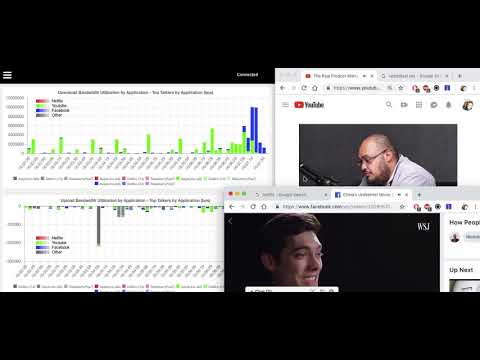
Video 1. First prototype of Netrics Passive in action (aka NetMicroscope). Software implemented in C with libwebsockets, libpcap, html, javascript, jquery, chartjs.
[WSJ Study](https://www.wsj.com/graphics/faster-internet-not-worth-it/)
 |
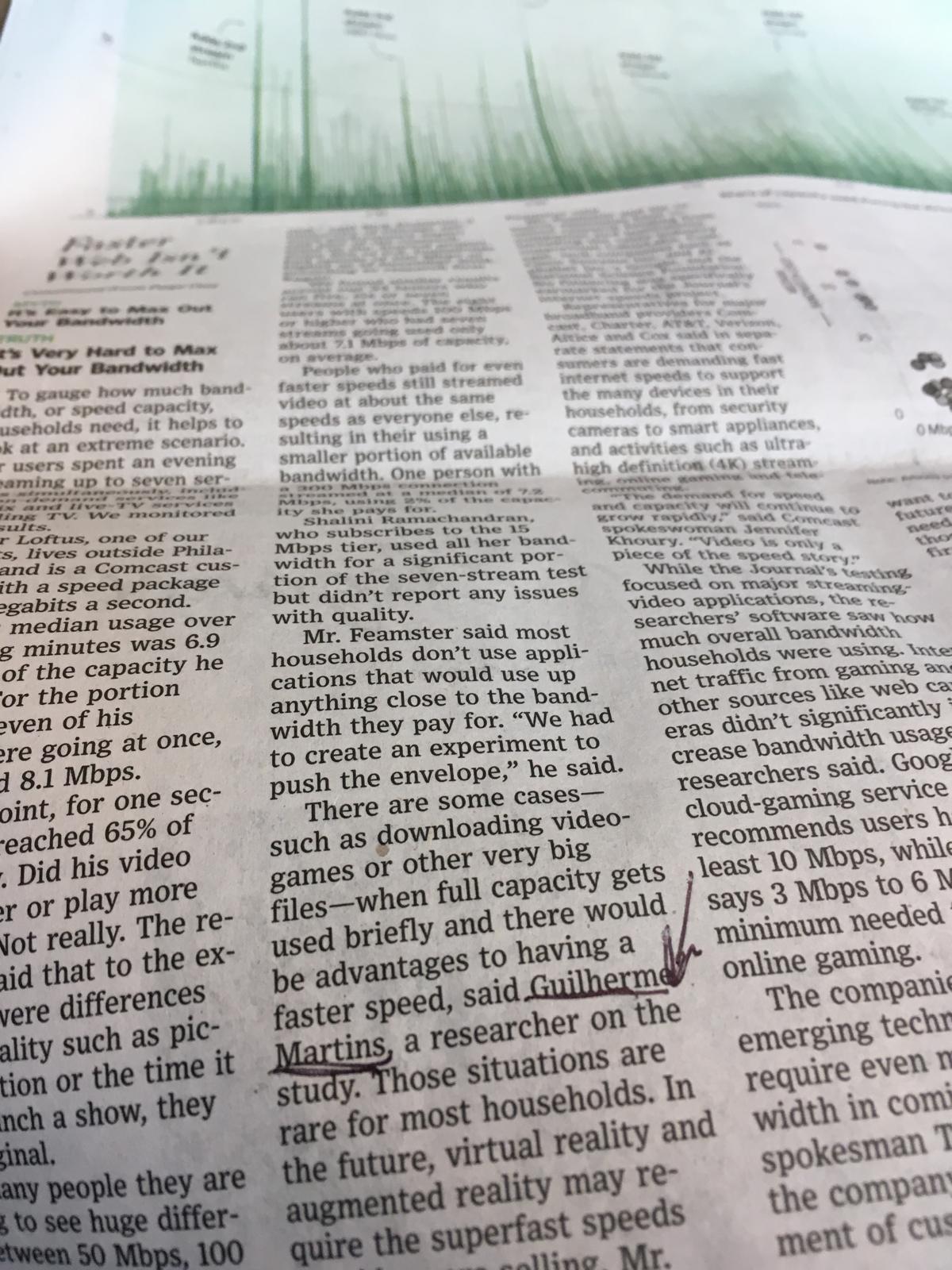 |
Figure 7. Netrics Passive Schematics developed circa 2015. A $200 kit (Jetson Nano 472 GFLOPS) for high-performance passive packet capture, network monitoring and ML inference. (Image generated with [IsomerJS]. Full source code [here].)
Figure 8. My earlier work (circa 2009-2011) on Deep Packet Inspection (DPI) for Alcatel-Lucent, programming CloudShield/IBM equipment (PacketC / C ). I was the principal engineer for the protocol/app service detection intelligence of the network traffic control engine called Agya. The solution was deployed in the Latin America region, mainly in Brazil.